Disclaimer
This formulation is an independent DIY experiment shared for educational and informational purposes, not a clinically tested or medically approved lubricant. My observations reflect my personal experience and should not be interpreted as evidence of safety or effectiveness for everyone.
Ingredient purity, measurement accuracy, pH, sanitation, preservation, and storage conditions can all affect the finished product. This formulation has not undergone formal testing for microbial contamination, osmolality, mucosal compatibility, or long-term stability. Commercial K-Lube powder contains preservatives, but their effectiveness in this modified formulation has not been established.
Sodium hydroxide is caustic and must be handled carefully. Use of this formulation, particularly on healing or sensitive tissue, carries risks of irritation, infection, or tissue damage.
Anyone reproducing or modifying this formula assumes responsibility for evaluating its suitability and risks. No warranty of safety, effectiveness, or fitness for any particular purpose is expressed or implied.
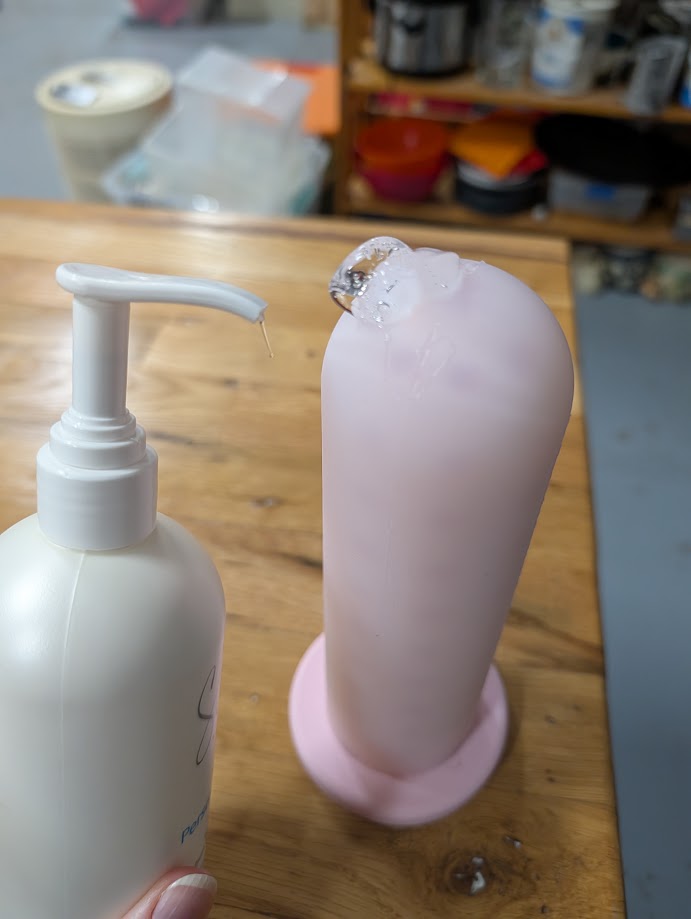
This post goes out to all the nerdles. I recently created a series of extra large (XL) dilators – larger than you can purchase anywhere. 2 inch, 2.25 inch, 2.5 inch diameters, with 6mm of ultra soft silicone and a rigid 3d printed core. I will have a separate post about the open source dilators.
It turns out there are no water based lubricants up to the ‘great squeegee’ when you ahem… climax while using an XL dilator and it gets ‘stuck’. For any dilator, you may find this formulation to be very useful and highly economical.
These are batches of 16oz, but you can scale them down for smaller batches to test.
XL Lubricant
*Use USP grade ingredients when possible
Distilled Water: 473 ml
Carbomer 940: 946 mg
K-Lube Powder: 1.89 g
Propylene glycol: 4.7 ml
Sodium hydroxide: ~0.4 g for a pH of 7
PH Test Strips that include the range of 4 – 8
Procedure
You’ll want to wear nitrile gloves for this probably.
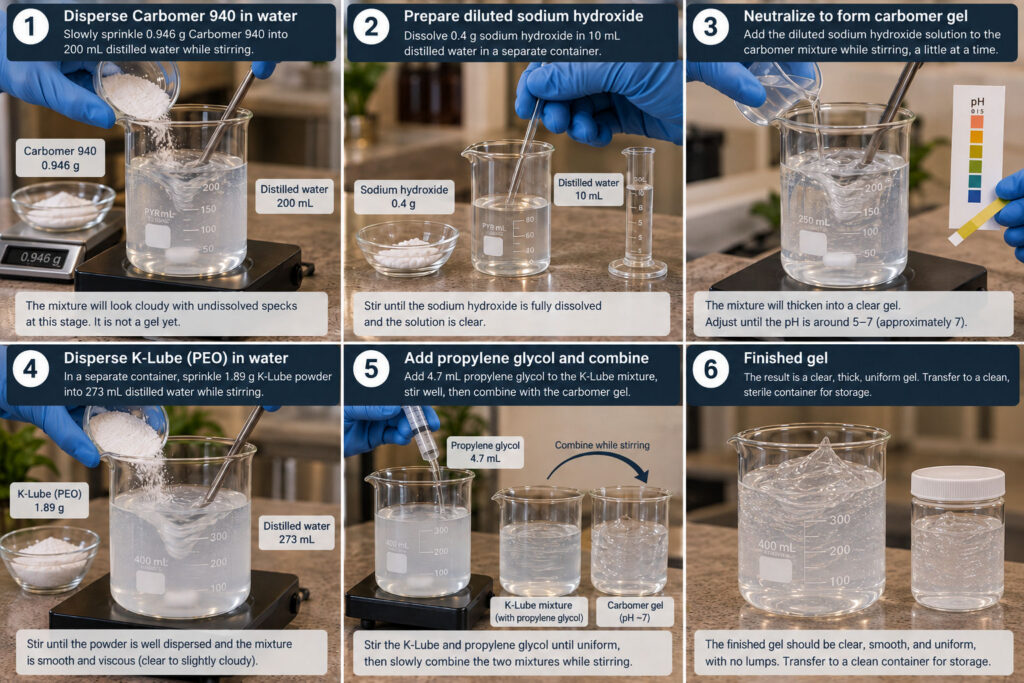
Pour 200ml water into a beaker and stir while adding the Carbomer 940. This will not dissolve very well, which is fine. Next, add 10ml water to a separate container and add the Sodium Hydroxide powder. Stir until dissolved fully. Next pour about half of the diluted Sodium Hydroxide into the Carbomer 940 beaker. Stir and you’ll find it slowly turns into a gel. Here’s the thing… Carbomer is going to unfold slowly into a gel and you can make it *really* thick if you want. You can adjust the PH accordingly by testing until you reach 5-7. A PH of 5 is going to be on the thin side for the lubricant; 7 is going to be *really thick*. Make according to your preference. Keep adding the Sodium Hydroxide dissolved in water until you are happy with the consistency.
Pour the remaining 273ml into a separate beaker and vigorously stir in the K-Lube Powder. You get ONE shot, so stir as you pour and keep going. If you have a magnetic stir plate, this is the time to use it. Once it has thickened and you’re not seeing a lot of particles in the water, STOP stirring to avoid breaking up the polymers too much. If you get clumps (fish eyes) you can spoon them out to avoid wasting the batch. Add the Propylene Glycol and mix together.
Finally, mix the contents of the 2 beakers together (the K-Lube and the Carbomer). This may become quite a bit of work if your batch is thick. Don’t worry, just try to get them mixed as best you can. I would not recommend a glass stirring rod for this, because it will probably break.
Here’s the magic – K-Lube is a terrible lubricant because it mostly sticks to itself and doesn’t coat things. Carbomer isn’t really much of a lubricant at all, it’s a gel. When you combine these two polymers, they work together to create a lubricating gel that sticks to more than itself and loses the overly stringy quality. The propylene glycol acts as a humectant and improves cling, similar to glycerine, but glycerine is way too sticky and feels gross. If you really want low stickiness, you can skip the propylene glycol, but the lubricant will dry out more readily and may not cling as well.
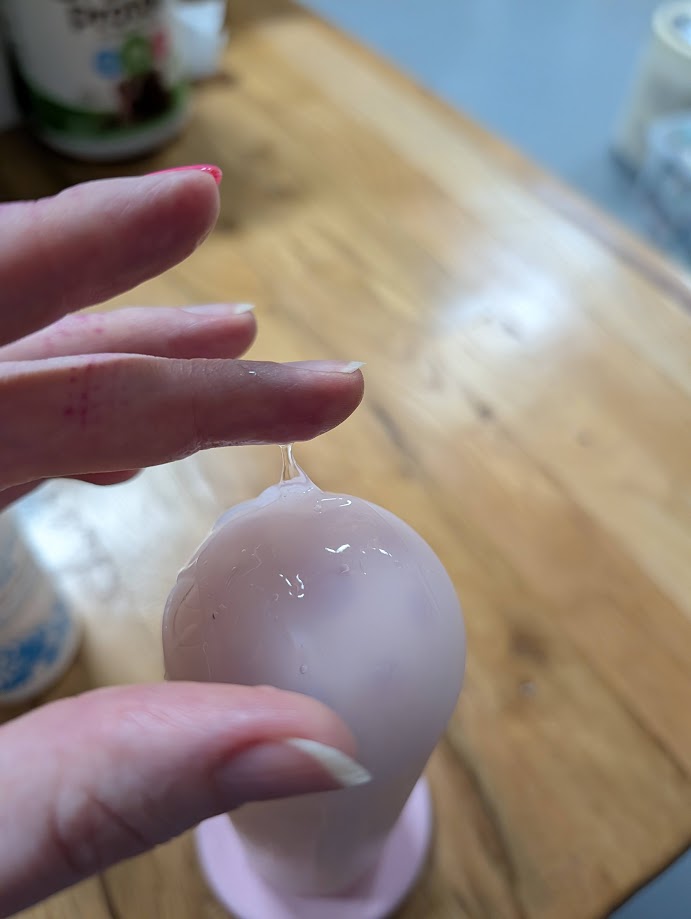
The end product will be quite viscous, transparent, and will coat and stick to dilators and toys readily. It’s actually pretty similar to Slippery Stuff Gel, but much better cling and stability. I prefer to use an old lubricant bottle for storage, and you can simply use the pump from the bottle, to pump the contents of the beaker into the bottle. K-Lube is a commercial product similar to J-Lube, except it includes preservatives for long shelf life. K-Lube is Polyethylene Oxide (PEO) plus preservative.
Roughly accurate AI generated instruction images
Economics
If you are dilating for the rest of your life, and prefer Slippery Stuff Gel lubricant, this formula is an easy and affordable replacement that actually works better. The below table would yield about 100 16oz batches of lubricant. (you would need to purchase more water)
This is roughly 96% less expensive that Slippery Stuff Gel per batch.
| Ingredient | Purchase size / price | Cost per batch |
|---|---|---|
| Distilled water | 1 gallon / $1.47 | $0.18 |
| Carbomer 940 | 100 g / $8.00 | $0.08 |
| PEO (K-Lube powder) | 200 g / $36.99 | $0.35 |
| Propylene glycol | 16 fl oz / $10.00 | $0.10 |
| Sodium hydroxide | 1 lb / $12.18 | $0.01 |
| Total | $68.64 | $0.71 |
Safety
The Sodium Hydroxide is a real hazard potentially so always be careful when handling. You’ll also want a milligram scale, and PH strips at least. For someone who is recovering from SRS, you’ll probably want to wait to use this DIY product until 3 or so months post surgery. Also, use USP grade ingredients whenever possible.
Pro Tip
With Slippery Stuff Gel or this lubricant, you can also pre-coat the dilator and let it dry. This will leave a coating. Add another fresh layer and you’ll get even more slide as you use it.
Reference Pictures