Disclaimer
This project documents my personal experience designing, manufacturing, and using custom extra-large vaginal dilators. The designs and instructions are shared freely for educational, experimental, and personal research purposes.
These devices are not medically certified or clinically tested. Although the design incorporates platinum-cure silicone, this does not establish that the finished device is biocompatible or safe for internal use. The silicone, 3D-printed core, mold-release agents, manufacturing process, and finished assembly have not been independently evaluated for biological safety, durability, or long-term stability.
Manufacturing defects, incomplete curing, exposed printed material, surface imperfections, or structural failures may cause irritation or injury. Additionally, vaginal dilation, especially at larger diameters or with sustained mechanical pressure, carries risks including tearing, bleeding, tissue damage, and complications involving healing or surgically reconstructed tissue.
The dimensions, techniques, and outcomes described reflect my individual anatomy and experience, and should not be assumed appropriate or achievable for others. Anyone reproducing, modifying, or using these designs does so at their own risk and is responsible for evaluating the materials, construction, and intended use.
No warranty of safety, effectiveness, or fitness for any particular purpose is expressed or implied.
Having had Sexual Reassignment Surgery (SRS) Peritoneal Flap Style with Jun Surgical, I was really struggling. The dilators they hard recommended, repeatedly, being the Soul Source Dilators, which have a curve that causes the tip to abrade the top tissue every single time you dilate. The curve is supposed to be to make entry easier, and it really does… but then the same curve rubs over and over. My hypergranulation had been treated 13 times with silver nitrate already. Finally as a shot in the dark, based upon Dr Powers suggestions on Reddit, I also tried Kenalog In Orabase (Triamcinolone Acetonide) – 0.1% (5g), which was very tricky to apply to the apex of my canal, using a piston type deposition I cobbled together. This helped, but you can guess, the dilators still agitated the apex and top of my canal consistently.
Finally going back to pelvic floor therapy, I was recommended the set by New Flora, which helped because they didn’t have the curve, and could hold Slippery Stuff gel, unlike some other straight dilators I tried. The apex of my canal was still having issues though. Why doesn’t anyone make a rounded tip to avoid stabbing the apex? Literally, no one makes it.
Finally in desperation I invented a new set of dilators that no one manufactures. I want to point out that this first open source release is the XL dilators only, because I don’t use anything under 2 inches diameter for dilation at this point; however, the models could be scaled for whatever size you prefer.
Features
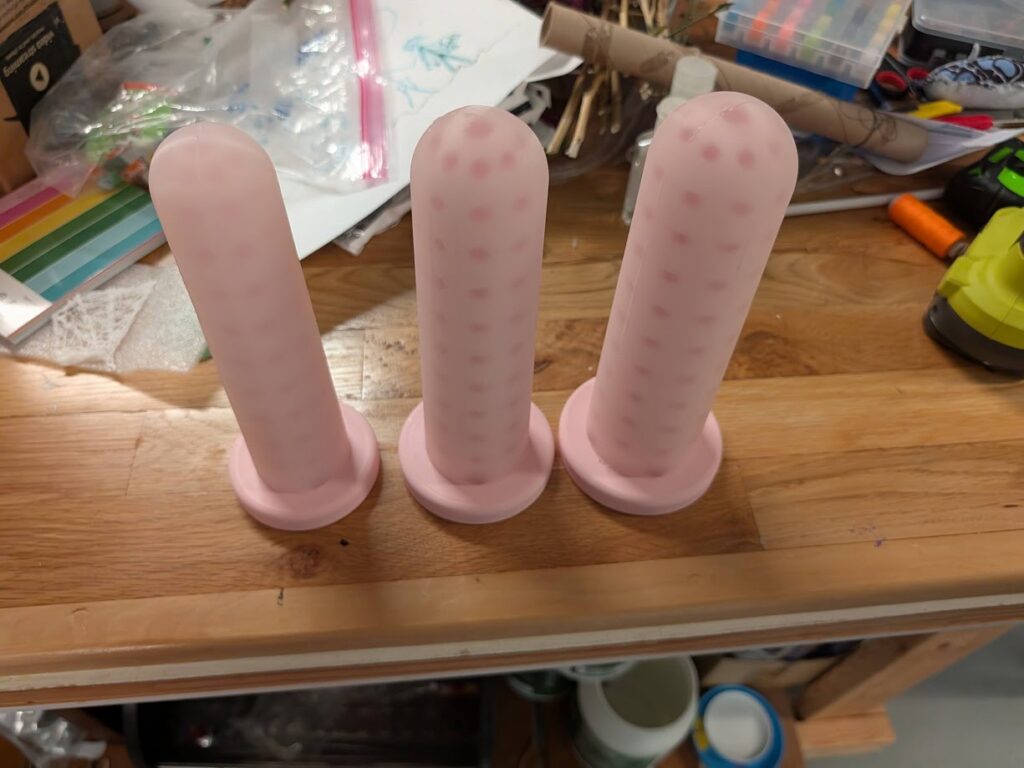
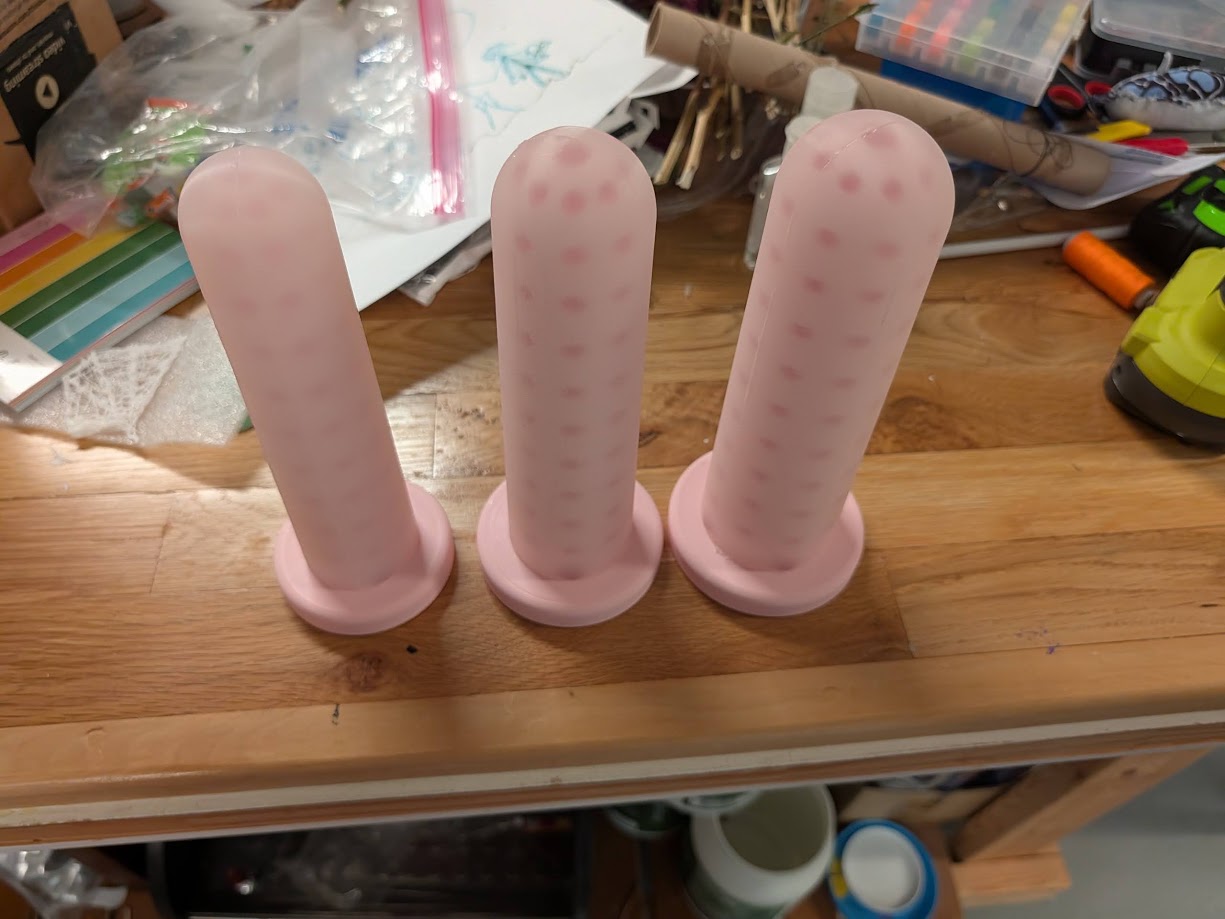
- 6mm ultra soft platinum cured silicone exterior
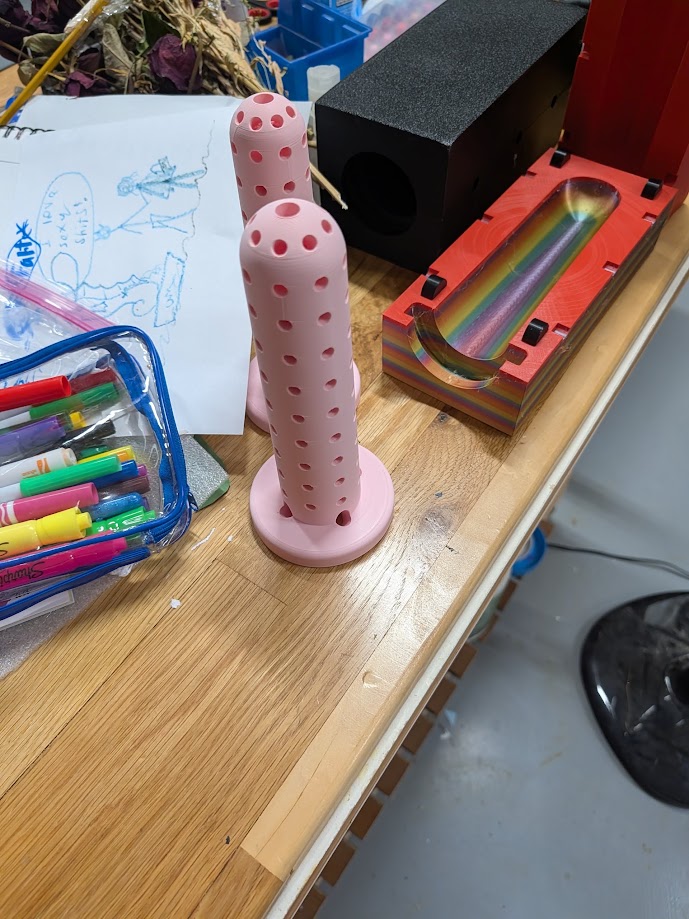
- Strong 3d printed rigid core that mechanically affixes the silicone, instead of a sleeve, and allows flow/air escape for the pour process
- Spherical rounded tip for applying high pressure to mechanically expand your canal gently and effectively
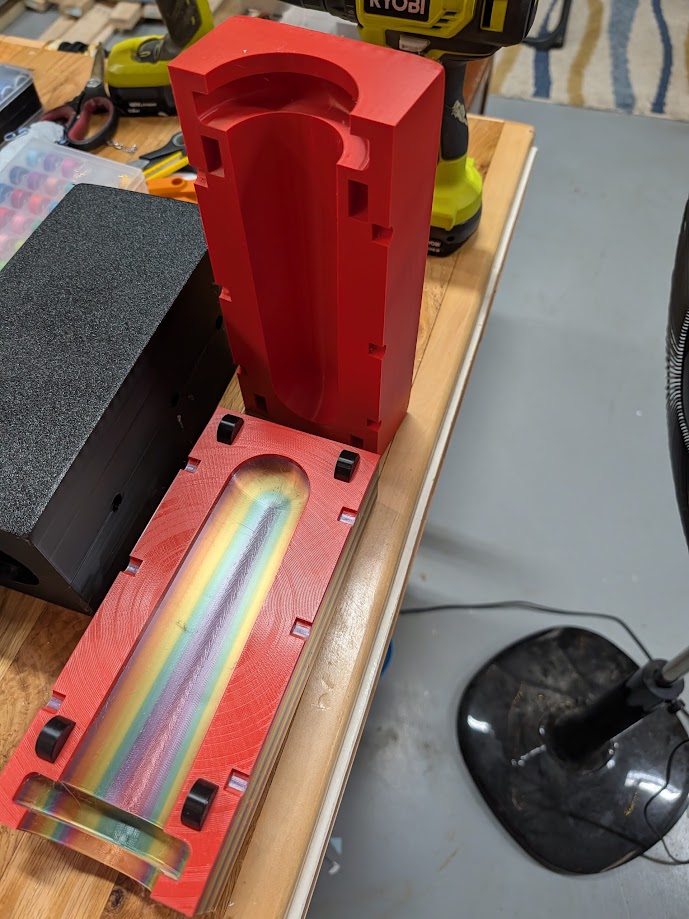
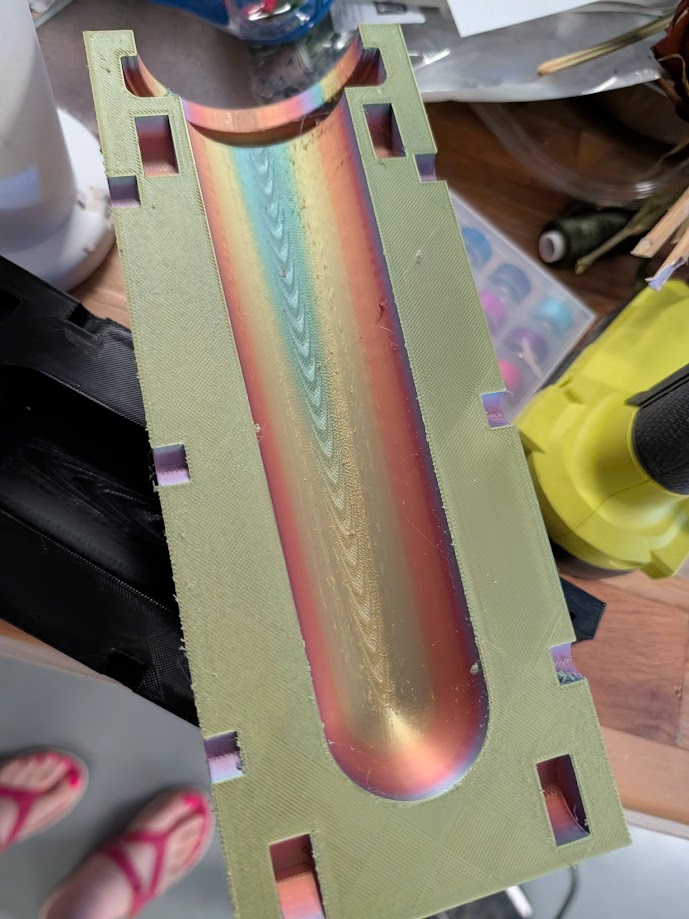
- 3d printed molds, which leave a fine texture useful for holding lubricant on the finished product
This design allows an unyielding core for mechanical expansion while dilating, yet is gentle on uneven tissues, hyper granulation, and most importantly the apex of the canal. Depth is the hardest thing to re-gain after a loss, and a pointy tip is prone to irritate the apex.
Why go XL for dilation?
- The extra size makes loss of the canal less likely in a circumstance where I’m unable to dilate
- If I encounter a particularly well endowed partner, I can accommodate them
- I can share double sided sex toys with cis women who are also well endowed
- I can use a wider range of sex toys
I’ve been exclusively using my custom XL dilators for many months now, and I would never go back to any other type at this point. Try to find dilators approaching the size of these, I think the closest I could find made by anyone was 1.7 inch diameter. I typically use 2 or 2.25 inch, but I also use 2.5 inch occasionally.
I am releasing this earlier than I expected to. I wanted to create a more standard set of dilators, but I just don’t have the time or inclination as I’ve worked well past the standard set. If someone out there finds this useful and makes a standard set of models, please contact me to post them here to help more people.
Products used for Manufacture
- Bambu Lab 3d Printer (I used A1)
- PLA Pure filament for the 3d printed Dilator core
- 00-30 Super-Soft Silicone Rubber Skin Like Translucent 2.2 Lbs
- Mann Ease Release 200, 14 Fluid Ounce Aerosol Can
Models used for Manufacture
Open Source Licensing
This project is shared in the spirit of open-source development, collaboration, and community improvement. You’re welcome to reproduce, modify, improve, and redistribute these designs under the following licenses.
Documentation and Illustrations — CC BY-SA 4.0
The original written instructions and original illustrations are licensed under the Creative Commons Attribution-ShareAlike 4.0 International License.
You may share, adapt, and redistribute this material, including commercially, provided you credit the original creator, identify modifications, and distribute adaptations under the same or a compatible license.
3D Models and Hardware Designs — CERN-OHL-S-2.0
The downloadable 3D models and associated design files are licensed under the CERN Open Hardware Licence Version 2 — Strongly Reciprocal.
You may manufacture, modify, share, and commercially distribute products based on these designs, subject to the license requirements, including making the corresponding design source available under the same license.
Attribution
Original project: Open Source: The Best Extra Large (XL) Dilators Money Can’t Buy
Creator: Enbyous Analog — Trans Icarus
Source: https://transicarus.com/open-source-the-best-extra-large-xl-dilators-money-cant-buy/
Safety and Liability
These designs are experimental and are provided without warranties of safety, fitness for a particular purpose, or medical suitability. Permission to reproduce or distribute the designs does not constitute certification, validation, or endorsement of any resulting device.
Users and manufacturers are responsible for evaluating the safety, materials, manufacturing quality, and regulatory requirements applicable to their intended use.
AI Generated Steps because I’m Lazy
Preparation of Negatives
- Print the rigid negative mold in PLA, preferably with fine layer heights for a smooth finish.
- Remove strings, burrs, and loose plastic.
- Wash and thoroughly dry the components.
- Use a very brief lighter flame pass to eliminate any remaining fine PLA wisps, taking care not to deform the plastic.
Preparation for Casting
- Apply a thin, even coating of platinum-silicone-compatible mold release to the negative mold.
- Position the internal core concentrically within the cavity, maintaining the intended silicone shell thickness.
- Secure the core so it cannot shift during filling.
- Close the mold halves, align their registration features.
- Use a clamp or weight to hold the mold halves together
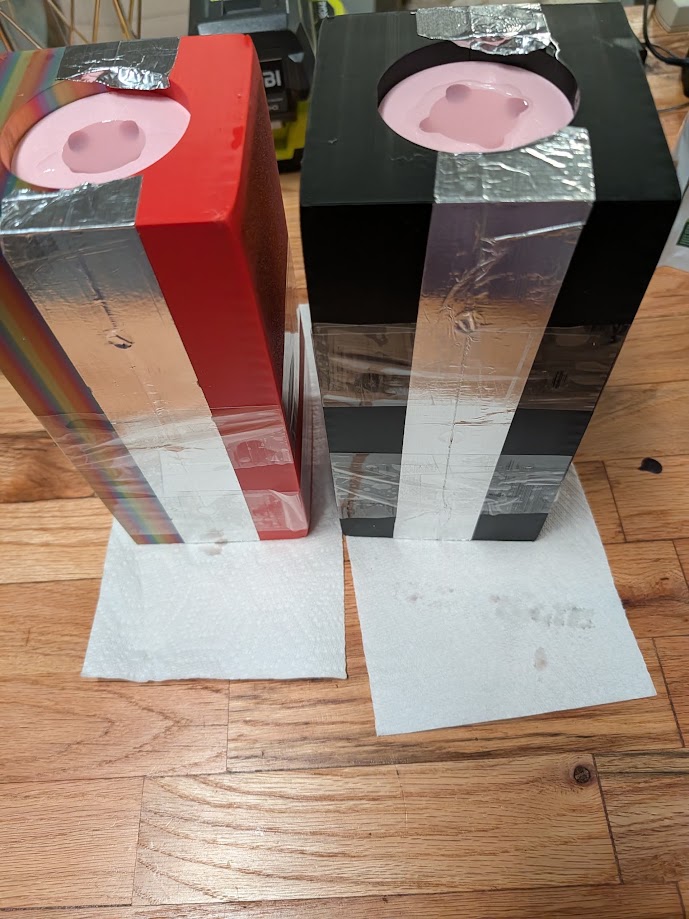
- Using duct tape, seal the edges to avoid liquid silicone escaping
Preparation of Silicone for Casting
For your 1:1 BBDINO silicone, measure equal masses of Part A and Part B, assuming the instructions on your particular kit specify 1:1 by weight. You will use most of the contents, so if you like you can mix the whole thing. Alternatively you can mix about 80% and incrementally mix a second batch to finish off. You will probably have some leaks so you can also top off the pour occasionally until it sets enough to avoid leaking.
- Pour Part A and Part B into a clean mixing container.
- Stir thoroughly, scraping the sides and bottom.
- Avoid vigorous whipping, which incorporates additional air.
Pouring the Silicone
- Introduce the silicone slowly through the lowest filling port.
- Allow it to rise around the embedded core.
- Let displaced air escape through the upper vent holes.
- Gently tap or tilt the mold as appropriate to release trapped bubbles.
- Watch for silicone emerging from the vents without bubbles.
- Continue until the cavity is filled, maintaining a small reservoir at the filling port.
- Use a Magic Wand vibrator to gently degass the mold via vibration; for about 30 seconds, because you probably don’t have a vacuum chamber and pump.
Curing the Silicone
- Leave the mold undisturbed on a level surface.
- Allow approximately 24–36 hours at room temperature, subject to the product’s actual curing instructions.
- Avoid demolding while the silicone is still tacky or incompletely cured.
Demold and Finishing
- Remove the duct tape and separate the rigid mold sections carefully. You will probably have to wedge a flat head screw driver near the base, then incrementally work around and carefully pry it open.
- The dilator will stick to one half of the mold and the trick to removing it is to carefully wedge the flat head screwdriver between the circular dilator base and the mold, then carefully leverage out the dilator. You’ll hear the silicone releasing. Be patient and careful to avoid damaging anything.
- Release the silicone surface without tearing it.
- Inspect the tip, shaft, and base for incomplete fill, voids, or exposed core material.
- Trim any flash from the mold seam and vent openings using a razor knife, or scissors.
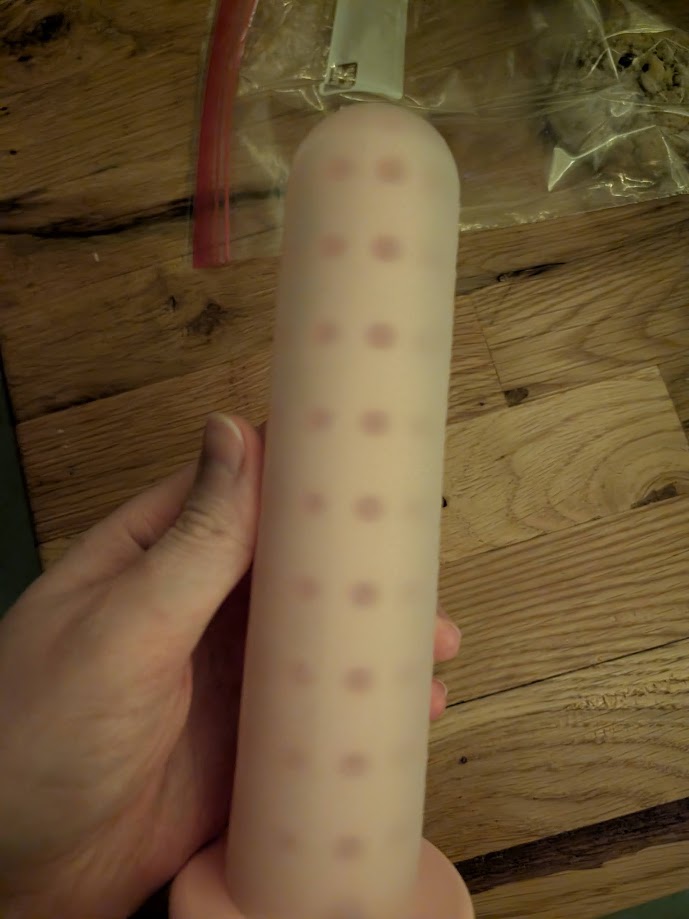
- Check the silicone surface for smoothness and confirm that the depth markers remain visible.
Preparation and Usage
- Give the dilators a good washing with a mild soap. You can use a gentle bristle brush if desired.
- Air dry or wipe dry
- Use a water based lubricant only
- If you are trying to size up, use the smallest first, then size up during the same session
- You can sit on these dilators if you are trying to mechanically expand your canal, but use pillows and be gentle. Stretching tissue takes time and consistent mechanical force, so holding with your hands will be tiring. Focus on more frequent sessions, rather than longer single sessions.
- Concentric expansion will be easier than depth expansion, but both are possible.
- Consider using my XL dilator lubricant formula if other lubricants are failing to be comfortable enough (aka dilator getting stuck)
Reference Pictures